Quick Facts
- Name
- Melanie Perkins
- Age
- 39
- Date of Birth
- May 13, 1987
- Nationality
- Australian
- Profession
- Co-founder and CEO of Canva
- Net Worth
- $9B-$10B+ estimated equity value
- Height
- Not publicly confirmed
- Status
- Active
Introduction
Melanie Perkins is one of the clearest examples of a founder who became wealthy by making a difficult tool simple. Canva did not win because design was new. It won because design software was too complex for millions of people who needed fast, good-looking results.
Perkins' story is valuable because it shows the power of starting narrow. Before Canva became a global platform, she worked on Fusion Books, a yearbook design product. That smaller market taught her the customer pain, the workflow and the sales problem.
Early Life
Melanie Perkins was born in Perth, Australia. While studying and tutoring design programs, she noticed that many students found professional design software intimidating. That observation became the seed of her founder insight: design should be browser-based, collaborative and much easier to learn.
Instead of starting with a huge abstract vision, she tested the idea in a smaller category. Fusion Books let schools create yearbooks online. It was not as famous as Canva, but it gave Perkins and her co-founder Cliff Obrecht a practical proof point. People wanted simpler design tools.
Career Journey
The path from Fusion Books to Canva was not smooth. Perkins has often been associated with the story of repeated investor rejection. That part is important, but not because rejection is inspiring by itself. It matters because she kept improving the pitch, the prototype and the proof.
Canva launched in 2013 with a simple promise: make design accessible to everyone. The product used templates, drag-and-drop editing and browser collaboration. A free plan created adoption, while paid plans added premium assets, team features and business tools.
Over time, Canva moved from simple social graphics into presentations, documents, video, whiteboards, print, brand kits and enterprise workflows. That expansion increased the company's addressable market without abandoning the original ease-of-use promise.
Net Worth in 2026
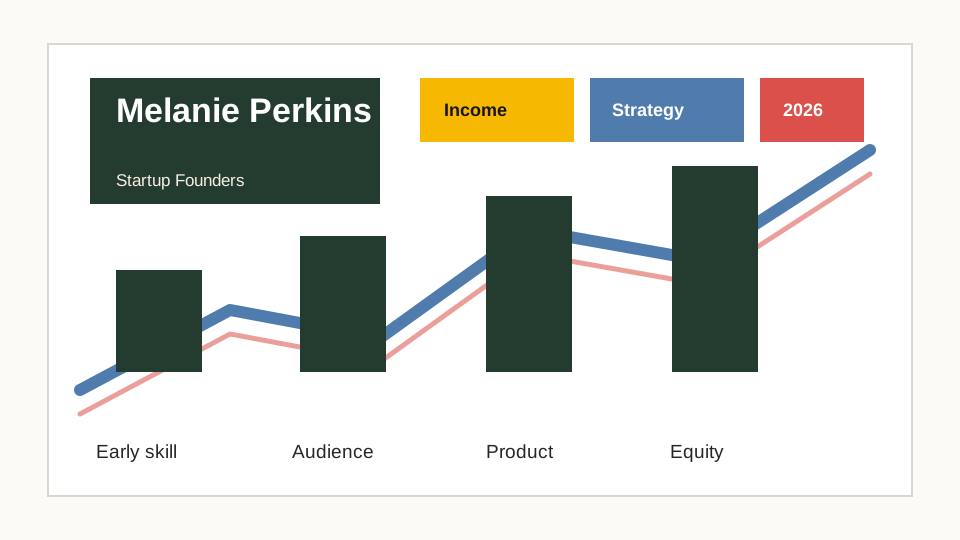
Melanie Perkins' net worth is tied mainly to Canva equity. Canva was reported at a $42B valuation in 2025, and wealth lists place Perkins and co-founder Cliff Obrecht among Australia's richest technology founders.
Because Canva is private, the number is not as simple as multiplying public shares by a stock price. Founder wealth can rise or fall based on secondary transactions, investor valuations, dilution and any future IPO.
Income Sources Breakdown
Perkins' income profile is founder-heavy.
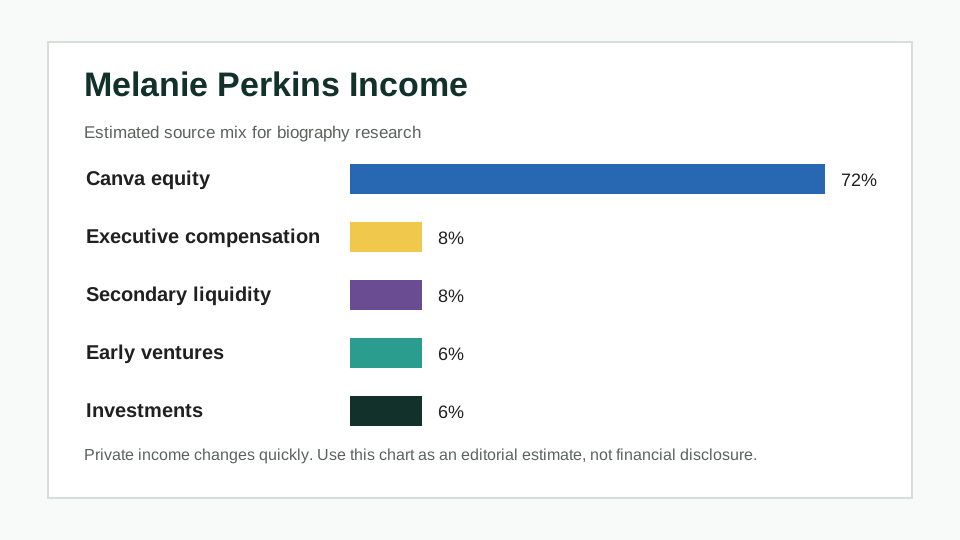
- Canva equity: This is the main wealth driver. Founder shares in a large private software company can be worth billions.
- Executive compensation: CEO income matters, but it is small beside equity value.
- Secondary liquidity: Private share sales can create cash for founders and employees before a public listing.
- Early ventures: Fusion Books was the learning ground that created the Canva opportunity.
- Investments and philanthropy vehicles: Founder capital can be invested, donated or allocated through long-term vehicles.
Estimated annual earnings are difficult because private equity gains are not the same as salary. The key number is Canva's valuation and Perkins' ownership.
Success Strategy / Business Model
Canva's business model combines freemium software with team and enterprise upgrades. The free product creates massive reach. Paid plans monetize power users, teams, brand managers, schools and companies.
The strategy works because templates reduce the blank-page problem. Users do not need to be professional designers to create something useful. That makes Canva valuable to marketers, teachers, small businesses, creators and enterprise teams.
Perkins' competitive advantage was not only product taste. It was persistence in fundraising, clarity about the user problem and a willingness to build a platform over many years. Canva did not have to beat professional design tools at every advanced feature. It had to win the much larger market of people who needed design without a steep learning curve.
Timeline
- 2007: Fusion Books began as an online yearbook design business.
- 2012: Canva raised early funding after repeated investor rejection.
- 2013: Canva launched publicly.
- 2015-2019: The platform expanded templates, teams and global adoption.
- 2021: Canva reached major private-market valuation milestones.
- 2025: Reports placed Canva at a $42B valuation.
- 2026: Canva remains one of the most important private software companies globally.
Personal Life
Melanie Perkins is often linked professionally and personally with Cliff Obrecht, her co-founder and husband. Public profiles tend to emphasize their long-term partnership, Australian roots and stated interest in using wealth for broad positive impact.
She also represents a founder type that is different from the loud public persona. Perkins' brand is less about constant personal content and more about product, company culture and persistence.
Key Achievements
- Co-founded Fusion Books, then Canva.
- Helped make design software accessible to non-designers.
- Built Canva into a global software platform.
- Created one of Australia's most valuable technology companies.
- Became one of the youngest self-made female billionaires through founder equity.
Interesting Facts
- Fusion Books was a focused test before Canva became a broader platform.
- Canva's templates are not just decoration. They are a growth mechanism that helps users get results quickly.
- The free plan is a distribution engine, while paid plans capture business value.
- Perkins' wealth is mostly unrealized private equity, not simple salary income.
FAQs
What is Melanie Perkins' net worth?
Melanie Perkins' net worth is usually estimated in the multi-billion-dollar range because of Canva equity. A 2026 estimate around $9B-$10B+ depends on private valuation assumptions.
How does Melanie Perkins make money?
Her wealth comes mainly from Canva founder equity, plus possible executive compensation, secondary liquidity and investments.
Why is Melanie Perkins famous?
She is famous for co-founding Canva and turning online design into a simple tool used by individuals, schools, teams and companies.
How did Melanie Perkins become successful?
She became successful by identifying a painful design workflow, proving it in a narrow market and then scaling the solution globally.
What is Canva's business model?
Canva uses a freemium model. Free users create scale, while Pro, Teams and enterprise plans generate recurring software revenue.
Conclusion
Melanie Perkins' biography shows that simplicity can be a billion-dollar advantage. Canva did not make design important. It made design usable for more people. Her story connects well with Alexandr Wang, Emma Grede and Ali Abdaal because all three turned a clear user problem into leverage.
Source Notes
Net worth and earnings are estimates unless the source is a public filing or a named wealth list. Private creator and founder income can change quickly.